3
Nov
How Piercing Studios and Body Jewelry Buyers Can Use AI Without Losing Product Accuracy
0
0
0
Artificial intelligence is becoming part of everyday business.
Piercing studios, body jewelry retailers and wholesale buyers can now use AI to help with tasks such as:
– product descriptions
– social media ideas
– merchandising concepts
– customer FAQs
– trend research
– inventory organization
– marketing content
Used properly, AI can save time.
But body jewelry is a technical product category.
That means there is an important line between using AI to improve business efficiency and allowing AI to make assumptions about materials, sizing, product compatibility or piercing safety.
For professional buyers, the best approach is simple:
Use AI to organize and communicate information — not to invent technical information.
Where AI Can Be Useful
AI is particularly effective when the information already exists and needs to be organized more efficiently.
For example, a studio or retailer might use AI to:
– organize product information into customer-friendly language
– draft social media posts around new jewelry
– develop display concepts
– compare different merchandising approaches
– summarize sales data
– generate ideas for seasonal promotions
– prepare basic customer-service responses
These are useful applications because AI is helping process information rather than replacing the underlying product knowledge.
1.sing AI for Product Descriptions
A body jewelry business may carry hundreds or thousands of SKUs.
Writing unique descriptions for every product can take considerable time.
AI can help structure product information when it is given accurate source data such as:
– material
– gauge
– length
– diameter
– stone type
– threading system
– finish
– product category
The critical point is that these specifications should come from the actual product record.
AI should not guess them.
For example, if a threadless titanium labret is made from ASTM F136 titanium, that specification should come directly from the supplier.
Body-Piercing.com lists technical product information directly on individual product pages, including material and dimensions. Buyers can also browse our Threadless Body Jewelry collection, where material and sizing information is shown for each item.
2. AI Can Help Explain Technical Terms
Body jewelry terminology can be confusing for newer buyers.
Terms such as:
– gauge
– internal threading
– threadless
– hinged ring
– labret
– ASTM F136
– PVD
– ball size
may be familiar to professional piercers but less familiar to newer staff or retail customers.
AI can help rewrite technical information into simpler language.
But again, the source information needs to be correct first.
For example, our guide on Threadless, Internally Threaded, or Hinged Jewelry explains how these construction systems differ and where they are commonly used.
AI can help turn that type of verified information into training notes or customer-facing explanations.
3. AI Can Support Merchandising Ideas
AI is also useful for brainstorming how products can be grouped.
For example:
– titanium essentials
– premium gold
– threadless systems
– clickers and rings
– nose jewelry
– new arrivals
– jeweled styles
A retailer could ask AI to suggest display structures or category groupings based on actual inventory.
This can help create clearer product presentations online or inside a studio.
However, the commercial decision still belongs to the buyer.
AI does not know which styles actually sell best in your market unless you provide it with real sales data.
4.AI Can Help Analyze Sales Data
One of the more practical uses of AI is identifying patterns in historical sales.
If your system allows sales data to be exported safely, AI tools may help identify:
– fast-moving SKUs
– slow-moving sizes
– repeat-purchase items
– strong materials
– seasonal changes
– products frequently purchased together
That can support better reordering decisions.
But AI should not replace actual inventory analysis.
A recently published Body-Piercing.com guide on planning a wholesale body jewelry assortment explains why core sizes, materials and reordering patterns matter more than simply carrying more designs.
AI can help analyze this information faster.
It cannot replace the information itself.
5.AI Should Not Guess Jewelry Size
This is where businesses need to be careful.
Body jewelry sizing depends on specific dimensions such as:
– gauge
– bar length
– ring diameter
– attachment size
AI may provide common sizes if asked.
That does not mean those dimensions are correct for a particular piercing, customer or product.
A professional piercer should still determine appropriate sizing based on the actual piercing and anatomy.
Wholesale buyers should rely on supplier specifications rather than generic AI recommendations.
Body-Piercing.com product listings show available measurements directly, helping buyers select the correct variations for their inventory.
6.AI Should Not Invent Material Claims
Material terminology matters.
There is a major difference between broad phrases such as:
“high-quality titanium”
and a defined specification such as:
“Titanium Grade 23 6Al-4V ELI ASTM F136.”
AI can sometimes simplify terminology too aggressively or make unsupported claims.
For technical product categories, this is risky.
Studios and buyers should always verify claims against supplier documentation.
Body-Piercing.com provides supporting material information through our Certifications section.
We also explain material considerations in our guide, What Makes Piercing Jewelry Safe? Materials and Standards Explained.
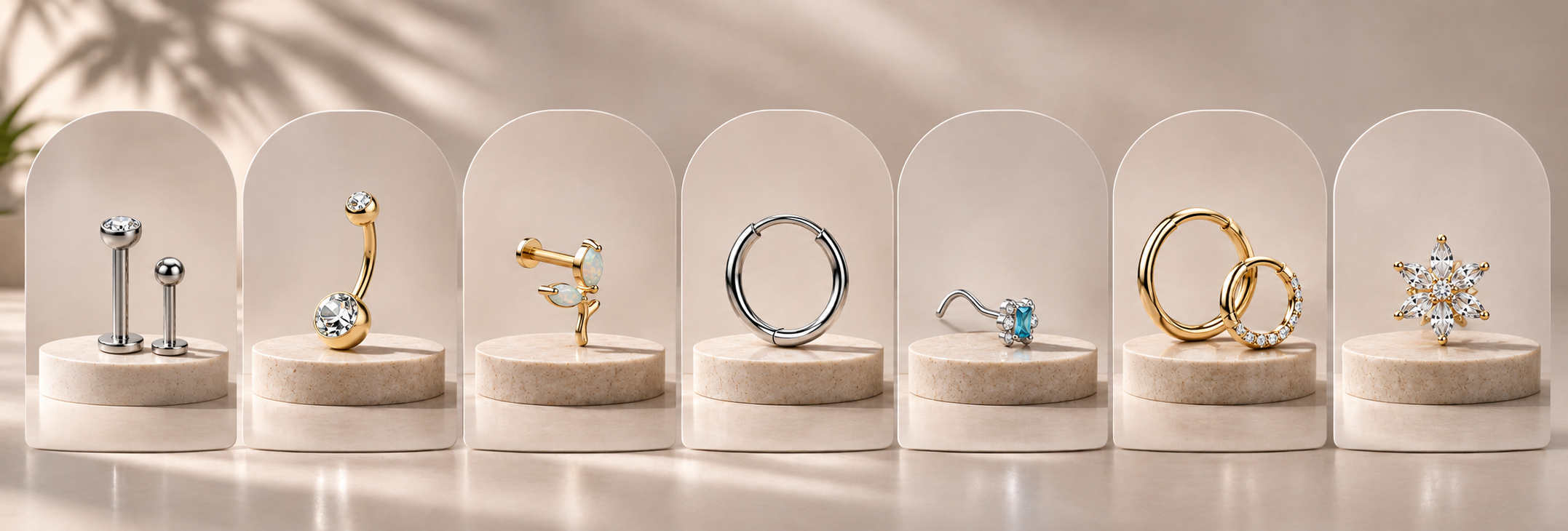
7.AI Images Can Be Useful — But They Are Not Product Photos
AI-generated images can help with:
– mood boards
– campaign ideas
– display concepts
– color combinations
– creative direction
But they should not be presented as an exact representation of a real product unless the image accurately matches the item being sold.
AI may:
– change stone counts
– alter proportions
– modify clasps
– nvent details
– create impossible jewelry constructions
For ecommerce, actual product photography remains important because buyers need to understand what they are ordering.
8.AI Cannot Determine Whether Jewelry Is Suitable for a Fresh Piercing
This is another important boundary.
AI can explain general information.
It cannot physically inspect:
– the piercing
– the tissue
– healing progress
– placement
– swelling
– irritation
Nor should buyers rely on a chatbot to decide whether a particular piece is appropriate for an individual client.
Professional judgment remains essential.
9.AI Can Improve Customer Service — With Guardrails
Studios and retailers increasingly use AI to help answer common questions.
That can work well for questions such as:
– Where is my order?
– What colors are available?
– How do I find a product category?
– What does threadless mean?
– Where can I find titanium jewelry?
But automated answers should be limited when the question becomes technical or health-related.
A useful rule is:
Automate information. Escalate judgment.
10.The Supplier’s Product Data Becomes More Important in the AI Era
AI tools are only as good as the information supplied to them.
That makes clear product data increasingly valuable.
Wholesale buyers should look for suppliers that provide information such as:
– material specifications
– dimensions
– product codes
– available variations
– technical documentation
– certifications
The cleaner the source data, the more useful AI becomes.
AI Is a Tool — Not the Authority
For body jewelry businesses, AI can save time and improve productivity.
It can help:
– organize
– summarize
– explain
– compare
– brainstorm
But it should not be allowed to invent product specifications or replace professional piercing judgment.
The strongest approach is to combine AI efficiency with accurate supplier data and human expertise.
Explore our Threadless Body Jewelry, review our Certifications, or browse the full wholesale body jewelry range when building accurate product information for your business.
Author: ITAY IZHARI